





Buying a wig is an exciting experience, but there is one crucial step you must complete beforehand: determining the correct wig size you need. An improper fit—whether too tight or too loose—can lead to problems. If it is too loose, the wig may shift out of place; if it is too tight, it can cause headaches.
This article will guide you through the process of measuring your head dimensions and explain whether you also need to measure the wig's length itself.
Note: Incorrect measurements can result in a wig that is too large and slips, or one that is too tight and uncomfortable.
Tools You’ll Need To Measure Your Head
Soft Measuring Tape (Cloth Tape): Please use the type of flexible tape measure typically used by tailors for body measurements; it conforms closely to the head to provide accurate data.
Mirror or Helper: Having someone assist you with the measurements is ideal. If you are alone, you can measure yourself using a mirror, but you will need to be extra careful to ensure you obtain accurate figures.
Wig Cap or Hair Clips: Use these to flatten or pin back your natural hair so that you can accurately measure your head circumference.
Use your mobile phone or a notebook to record your measurements.
Step-By-Step: How To Measure Your Head For a Wig (5 Key Measurements)
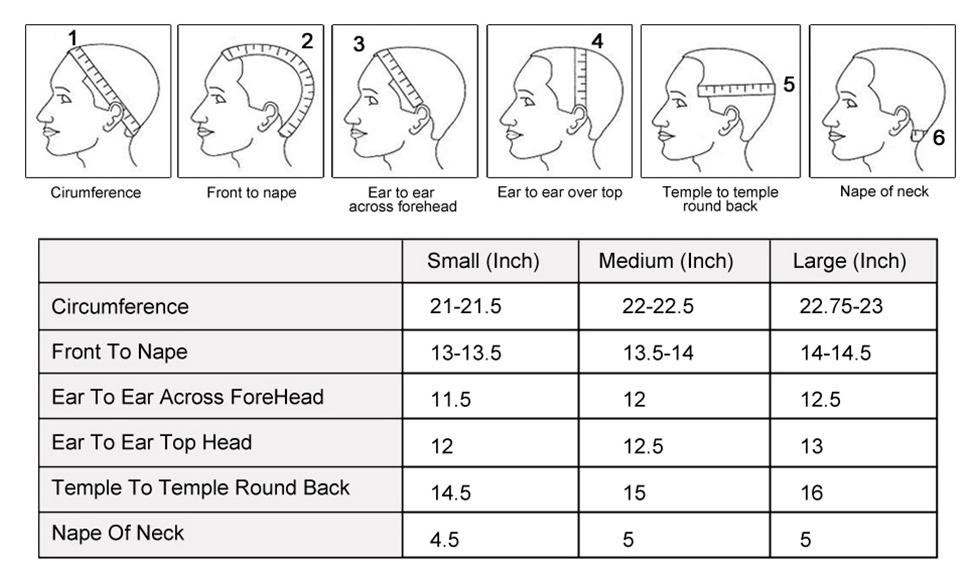
1.Circumference (Head Perimeter)
Start at the front hairline, wrap the tape around your head—passing above the ears and around the nape of the neck—and bring it back to meet the starting point at the forehead. This constitutes your head's circumference.
2. Front To Nape
Measure from the center of your front hairline, over the crown of your head, down to the hairline at the nape of your neck (extending to the lowest point of the hairline). This measures the length from the front of the head to the nape.
3. Ear To Ear (Across Front Hairline)
Measure across the forehead, starting from the hairline just above one ear and extending horizontally across the brow to the hairline just above the other ear. This measures the distance from ear to ear across the front hairline.
4. Ear To Ear (Over Top)
Measure over the crown of the head, passing above both ears. Place the starting point of the soft tape measure at the highest point of the hairline above one ear. Extend the tape vertically upward over the very top of your head (the crown), and continue downward to the highest point of the hairline above the other ear. H3: 5. Nape of Neck Width – Horizontal Width Between the Hairlines at the Back of the Neck
Place the flexible tape measure at the lowest point of the hairline behind one ear; extend it horizontally across the back of the neck to the corresponding point on the hairline behind the other ear.
Common Mistakes To Avoid When Measuring
Pulling the tape measure too tight or too loose: The tape measure should sit as flush as possible against your head—aim for 100% contact—mimicking the exact sensation of actually wearing a wig.
Forgetting to tidy your hair: If your natural hair isn't smoothed down or tied back securely, your measurements will be significantly inaccurate, potentially leading you to purchase a wig that is too large.
Failing to double-check your measurements: Taking multiple measurements allows you to verify the accuracy of your data and helps you avoid unnecessary complications later on.
How To Use Your Measurements: Wig Size Chart Reference
Examples of Typical Small, Medium, and Large Head Circumference Ranges
|
Wig Size |
Circumference Range |
|
Petite / Small |
21" – 21.5" (approx. 53.3 – 54.6 cm) |
|
Average / Medium |
22" – 22.5" (approx. 55.9 – 57.2 cm) |
|
Large |
23" – 23.5" (approx. 58.4 – 59.7 cm) |
Recommendation: If the size falls between two sizes, choose the larger size. Adding the adjustment strap will ensure a snug fit. Buying the small size is a major drawback as there's no way to adjust it further.
Final Checklist Before You Order a Wig
Have you completed all 5 head measurements?
Have you accurately read the brand's size chart?
Have you confirmed the wig's construction (whether it's made entirely of lace, elastic mesh, has an adjustment buckle, etc.)?
Conclusion: Measure Once, Buy with Confidence
Taking the time to measure your head is a one-time effort. Next time you buy a wig, you can directly use these measurements for convenience. You'll be confident in buying the right wig for you when purchasing any wig online in the future.
Product Recommendations For Drawstring Wigs (No Measuring Needed)
I recommend several popular adjustable drawstring wigs. No complicated measurement steps are needed; don't worry about the size, just wear them directly. They're suitable for both large and small head circumferences.


Frequently Asked Questions (FAQ)
Q1: Can I use a string instead of a soft tape measure?
Yes! If you don't have a flexible tape measure, wrap a piece of non-stretchy string or yarn around your head following the steps above. Mark the string with a pen, then lay it flat against a standard hard ruler to get your measurement.
Q2: What if my measurements fall between two sizes?
Go with the larger size. It is much easier to secure a slightly larger wig using the adjustable straps
Q3: Do I need to measure my head differently for a lace front wig?
No, the measurement technique is exactly the same. However, when wearing a lace front wig, paying extra attention to your front-to-nape and ear-to-ear across the front hairline measurements is vital.